

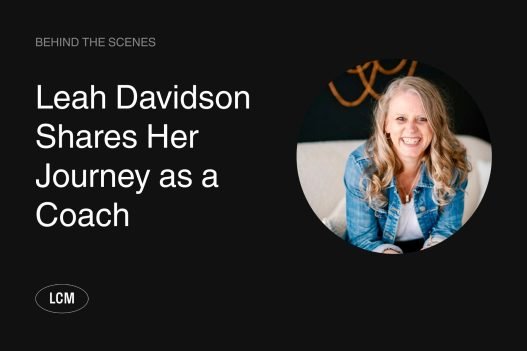

Leah Davidson’s coaching practice helps people understand, befriend, and regulate their nervous systems through education, somatic tools, and mindset work. She offers memberships, courses, and creative resources—including journals and stationery—to help people move from survival to safety, reduce stress, and build lasting resilience, calm, and connection.
Business Name: Leah Davidson Life Coaching
Location: Toronto, Ontario, Canada
Connect: Website | Instagram | Facebook | Podcast | Shop
Tell us about your journey as a coach.
I’ve spent over 26 years as a Speech-Language Pathologist, working in the area of traumatic brain injury. Over time, I began to see that true healing and resilience weren’t just about what we think – they’re deeply tied to how safe and supported our nervous system feels. That realization led me to pursue additional training in life coaching and trauma-informed care and really start to integrate and teach simplified nervous system science.
I officially started offering coaching in 2019, blending neuroscience, psychology, and somatic tools to help people understand and work with their nervous systems instead of against them. Since then, I’ve coached hundreds of clients – individuals, professionals, and fellow coaches – helping them regulate their stress responses, recover from burnout, and rebuild trust in themselves.

Today, my coaching practice has evolved into a full ecosystem that includes my Connections membership for deeper coaching and community, the Nervous System Journaling Club for creative regulation, and a line of guided mental health journals and stationery under my brand Resilient Brilliance. I also host the Building Resilience Podcast and lead workshops, international retreats, and Advanced Trainings for coaches and clinicians who want to integrate nervous system science into their work.
My mission is simple: to teach people that their nervous system is their most valuable resource and that when they learn to befriend it, everything else changes.
If you feel inclined, share any relevant revenue figures from your business.
My first year coaching I made about 10K, and slowly built up to over 6 figures after 4 years. It was only in the last 18 months that I stopped taking SLP clients – although I still see some individually. People told me I had to choose one or the other – but I knew I wanted to find a way to merge my worlds.
How did you get your very first paying client?
I did a month of daily Facebook Lives, and someone reached out for coaching.
What worked best for you to find and attract clients in the early days?
I joined directories, was consistent on social media, and tried to get on podcasts.
How did you decide on your niche, or what would you say to someone who’s struggling to choose one?
It was a natural progression for me, given my background as a Speech-Language Pathologist. I knew mindset was important, but the nervous system came before mindset – and that seemed to be missing.
I believe that YOU are your niche – what you stand for, value, your experiences, etc.
What training or certifications, if any, made the biggest difference in your career?
Every certification and training was beneficial – I took something out of each one and have used portions in all that I do.
Do you recommend offering free sessions, and if so, how should new coaches approach that?
Yes, absolutely. The more experience you get, the better for you and your clients.
Do you offer free consultations? Why or why not?
Yes – I try to have a variety of offerings – free, low cost, mid cost, high ticket. There are different access points, but obviously they vary in depth too.
What helped you overcome imposter syndrome when you were just starting?
It’s ok to have imposter syndrome at first – you are new! You do need practice and time invested – and education. Don’t be afraid to not know – and find out.
What beliefs about coaching or business were most helpful as you grew your coaching practice?
-Success is inevitable as long as I keep trying – because I get to define success.
–I don’t always know how, but I know it is possible.
How do you structure your sessions or packages for clients?
I currently have memberships, but for my 1:1 clients, I either do 12-week packages or 4-week ones that they can get as add-ons.
How do you keep growing as a coach?
Ongoing trainings – I am a lifelong learner. I love to be in masterminds, and I love meeting other entrepreneurs and hearing and learning new perspectives.
How do you maintain your own energy and mindset as a coach?
For me, the most important thing is taking care of my nervous system. Learning what I need to do on a daily basis to process stress, refuel, etc. Movement, journaling, connection – so important for me.
Do you have any examples of how a “failure” set you up for later success?
About 10 years ago, I started a travel company as a side gig (I was interested in coaching but decided that travel won). I did it for 3 years – a lot of work for not a lot of success. I figured I had wasted time — but fast forward to this past fall where I hosted an international retreat in Italy – full circle using my travel experience too!
How has your approach to coaching evolved since you started?
It’s more body-focused. I’m personally very cognitively driven. My role as a SLP was always very cognitive too, but when I integrated nervous system work, that’s when everything changed.
What’s one trend in the coaching industry you’re excited about right now?
People are becoming more trauma-informed and realizing that the brain and the body are both important.
Is there something you thought was really important as a new coach, but later realized wasn’t?
A Website – I still need to work on mine!
What do you think new coaches need to understand in order to build a successful, sustainable practice?
How important their nervous system is (can you hear a theme in my answers) – your nervous system is your most valuable resource.
If you could give one piece of advice to every coach reading this, what would it be?
Learn about your nervous system – you will need those skills personally and with your clients.

The Life Coach Magazine staff is your team for high-quality content on topics from personal development, to coaching tips, to how to grow your coaching business.








This has started my deep dive into Neuroscience, Psychology, and Somatic Tools. This will be my coaching education focus for the remainder of the year. Thank you for such a wonderful topic.